
The Sidney Calm Down Method
And Buddhist Mind Training on Impermanence


When I was eleven or twelve years old — 1970, 1971 — the world was on edge. The horrifying Vietnam War was on television every night. That was piled on top of the nuclear dread that was baked into every Boomer childhood, and especially pronounced in the Washington, D.C. area where I grew up. Things were not tranquil at home either.
I decided I needed a system to help me in the event of an emergency. I called it the Sidney Calm Down Method. (Sidney was my name then.) This is how it went: If anything sudden and bad happened, I would say my name — Sidney Skinner — then my address: 1047 26th Road, Arlington, Virginia. Then I would continue outward: United States. North America. Earth. Solar system. Universe. That was it. That was the whole method.
I needed to use it sooner than I expected. My parents took me on a Caribbean cruise that year, on what would now be considered an antique ship. One afternoon, bored by the excursion plans, I asked to stay on board while they went ashore. Back in my little cabin, my bed was a heavy, clamshell-like couch that the stewards opened every evening for me, and closed every morning, turning it back into a couch. What I didn’t know was that there was a strap you had to secure to keep it open.
After my parents departed the ship, I pulled the bed open and threw myself onto it. It instantly folded up with me inside, like a Venus Flytrap.
There I was, sandwiched inside with only a tiny pocket of air around my nose and mouth. I thought: if Mom and Dad come back and find their dead daughter inside the sofa… that would be bad.
So I used my method. Sidney Skinner. 1047 26th Road. Arlington, Virginia. United States. North America. Earth. Solar system. Universe.
I got my wits about me and remembered that there was a call button on the wall, just in reach. I slowly wiggled my fingers and wrists and eventually worked my hand toward the opening, thinking I might be able to get it out of the sliver-like opening above me, feel where that button was, and press it.
I remember noticing that I could still breathe, although the air was hot and stale. Time slowed down and, bit by bit, I worked my little arm out. With that, the center of gravity shifted, and the bed opened.
I was alive!
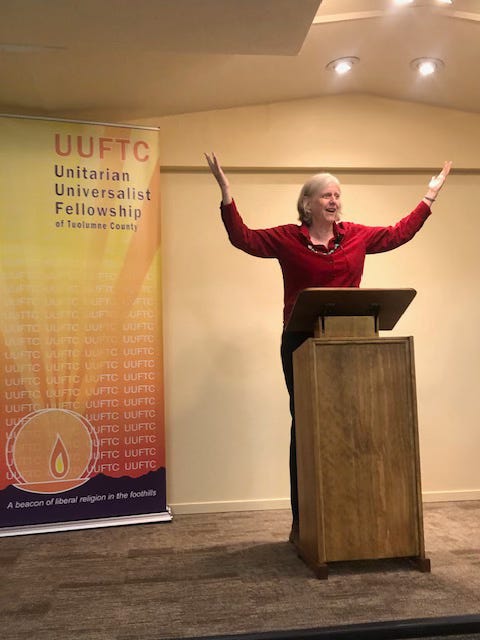
This was the story I opened with last Sunday, when I was a guest speaker for the Unitarians of Tuolumne County, invited to speak on grief, loss, and impermanence. The congregation was warm and curious — rural elders, many of them, with their own hard-won relationship with change and loss. I think The Sidney Calm Down Method landed with them.
For my Substack readers, half of whom I suspect have been practicing Tibetan Buddhism for a very long time, this story has an obvious punchline. What I invented at age eleven in a moment of childish desperation was a rudimentary form of mind training. I had stumbled into the logic of the practice without anyone teaching it to me: locate yourself. Widen the frame. Let the emergency become small inside something vast.
The More Sophisticated Version
In Tibetan Buddhism, and really in all forms of Buddhism, we train in impermanence. In my own tradition, there is a liturgy we recite each morning. It has nine parts, four of which are formal mind training exercises — deliberate practices of reorienting how we think about the world and our place in it. The section on impermanence in the text we use goes like this:
The world is impermanent, like an external vessel that comes into being, endures, and disintegrates. Sentient beings, the inner contents of that vessel, are born and die. They roam about buying and selling over a period of years, months, and days. Strutting around like performers on a stage. Help me be mindful of impermanence and death, my teacher. Know me.
A lot of people, hearing that for the first time, find it harsh. And it does have an edge to it. But that edge is the point. Our mind doesn’t really want to train itself in the reality of impermanence. Left alone, it will drift toward fantasy, toward the comforting assumption that there is a “normal” state that things will either remain in or get back to.
I was once the Director of Nursing of a nursing home in Oakland. I remember a resident’s daughter, herself seventy years old — who spent a lot of time at the bedside of her ninety-year-old mother there. But this daughter needed renal dialysis three times a week, so she was off doing that one day when her mother passed away. When she came back and understood what had happened, she sat in the worker’s office and wailed. “How could this possibly happen to me?”
The social worker and I caught each other’s eyes as we thought the same thought. Of course, it was going to happen to you. Your mother was ninety!
Grief is real, physiological, not something to be argued away — and her keening was genuine, uncensored, entirely human. But the belief underneath it, the belief that she had somehow been singled out for something unfair, that was the added suffering on top of the grief. The grief itself needs to be felt. The added layer is optional.
The Big Circle
In Tibetan Buddhism, we understand life as a great circle. There are four sections to it. The first is the intermediate state of this life — the bardo we are in right now. The second is the process of dying. The third is what follows death: a brief, brilliant encounter with the true nature of reality, what is sometimes called the clear light. If the practitioner can recognize it, they will awaken into Buddhahood. If not, they will experience the Bardo of Becoming, where there is a gradual drift toward rebirth — a new orientation toward a body, parents, a realm of existence — and then the first bardo begins again.
Training our minds in this entire arc, rather than in just the slice of it we happen to be standing in, transforms our relationship to unwanted changes. Not because it makes us feel nothing when loss happens. I know Lama Tharchin Rinpoche during the period when his teacher died. The sharp, painful sadness of grief came and went in him. He was not a rock. None of us are supposed to be rocks.
This mind training changes our relationship to the arising of unwanted circumstances. Grief arrives, but it does not come as a shock, as an insult, as evidence that something has gone terribly wrong with the universe. It lands as a simple, fresh experience of what it is to have loved something in a world where things end.
Practices for Every Stage
One thing I appreciate about Tibetan Buddhism, from a purely practical standpoint, is that it provides practices for every part of the circle, not just this life. There are practices for dying, for the post-death state, for recognizing the true nature of reality, even for the transitional period before rebirth. We have a toolbox for how to work with our minds when a certain experience arrives.
Ceremony and community play a role, too. In most traditions, there are rituals for the major transitions — coming of age, death, the passage from one state to another. In Tibetan Buddhism, your lama and sangha support you with practices not only during your life but also afterward, continuing to hold you in mind through the practices they do on your behalf.
A student of mine who works as a death doula. She described a workshop where participants made their own death shrouds — dyed them themselves in natural indigo, beautifully designed for their own bodies. I found that genuinely moving to hear about. There is something about making the thing yourself, and knowing you will be in it, that pierces through the usual avoidance. They weren’t morbid. They were preparing. That is a kind of mind training that can be done by people regardless of whether they believe in the continuity of consciousness beyond death.
Your Own Method
My message to the Unitarians was, whatever your tradition, it is worth thinking about your own Sidney Calm Down Method for impermanence. Not just for dramatic emergencies, but for the ordinary losses — the friend who moves into a nursing home, children graduating from high school or college and leaving the nest, job loss, and so on.
I had a chance to test myself once. I was living up in a remote town in the Sierra Foothills — even more remote than the one I live in now — and I had sudden chest pain that radiated down my arm. My phone was across the room. I couldn’t reach it. My body went into rigors (an experience I don’t recommend).
It turned out to be food poisoning, not a heart attack. But in those minutes, I had to actually try to apply what I had spent decades training in. It was harder than it sounds. There was a lot of self-talk involved, but the physical state of my body was screaming for my attention.
So, I recommend training in impermanence a little each day, facing reality in a way that works for you.
Sidney Skinner. 1047 26th Road. Arlington, Virginia. United States. North America. Earth. Solar system.
Universe.
—
Yudron Wangmo is a Nyingma lama and the spiritual director of the Mayum Mountain Foundation. She is the author of Clearing the Way to Awakening and its companion workbook.
I’ve had two experiences of death anxiety, one from an accidental overdose (prescription dose prescribed turned out to be too high) and one a mysterious illness, both before I knew anything about Buddhism. The first time I just focused on trying to remain alive, but the second time I distinctly remember lying in bed and thinking it’s okay if I die. I’m hoping when the actual moment arrives, I will not be in such agony that I can’t relax and meet death with joy like a true yogin.
Thank you for your wonderful story and reminder of the benefit of our practice. Much appreciated, Lark